
Online Banks vs. Brick-and-Mortar Banks: What Changes and What Doesn't

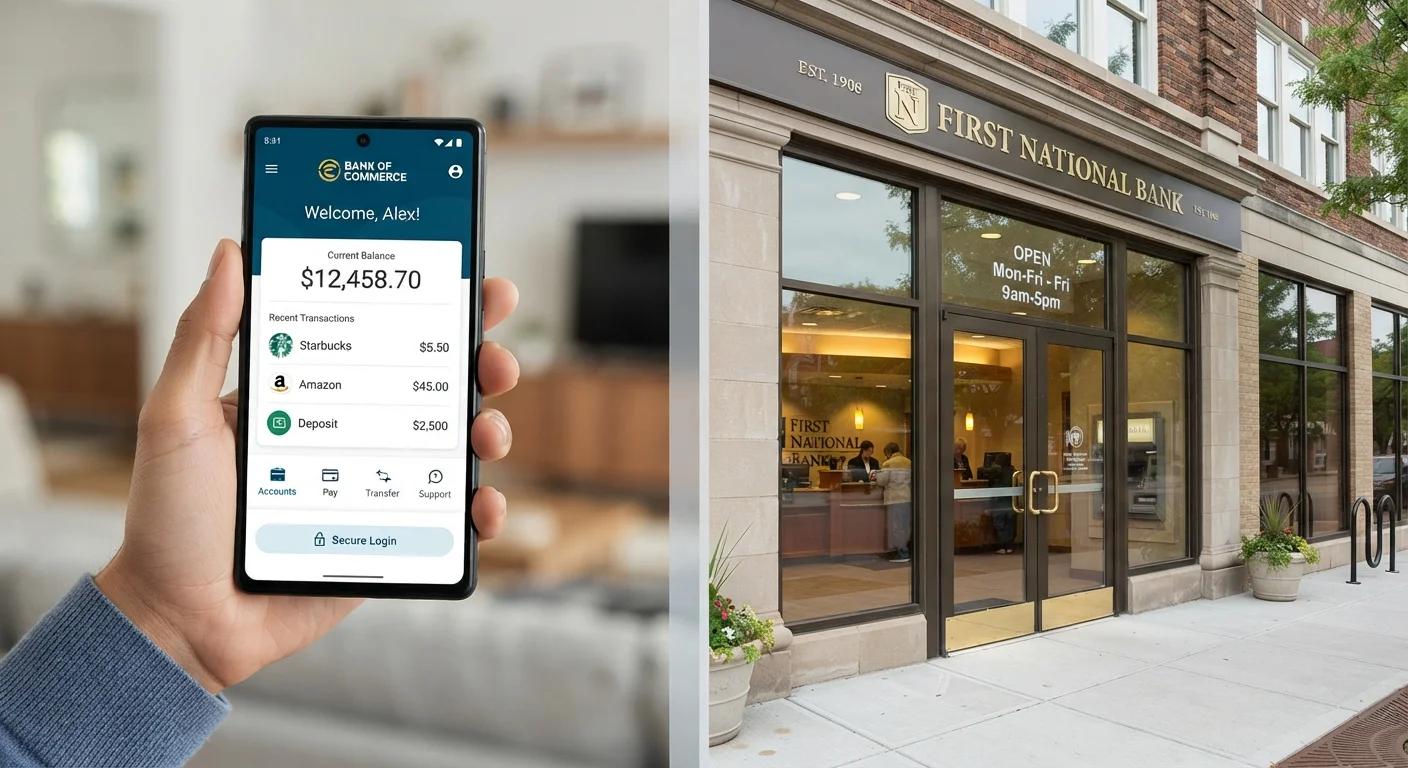
Photo: InsightsVilla.com | Quick Search. Right Info editorial
Key Takeaways
- Online banks typically offer higher interest rates and fewer fees than traditional banks.
- Brick-and-mortar banks provide in-person service and often a wider range of loan and financial products.
- Both bank types are generally FDIC-insured, meaning your deposits are protected up to the same federal limit.
- Many people find that using one of each type covers most everyday banking needs.
- The right choice depends on how you prefer to manage money and what services you actually use.
The Core Difference: Where the Bank Lives
The most obvious distinction is physical. A brick-and-mortar bank operates branch locations where you can walk in, speak with a banker, and handle transactions in person. An online bank exists entirely (or almost entirely) on the internet - you manage your accounts through a website or mobile app.
That structural difference ripples out into costs, rates, and the kind of service each type can realistically offer. Traditional banks carry the overhead of maintaining buildings and branch staff. Online banks don't, and they often pass those savings along through higher deposit rates and lower fees.
If you're new to banking altogether, this plain-language guide to everyday banking explains the basic tools - checking accounts, savings accounts, and how deposits work - before you start comparing institutions.
Where Online Banks Have a Clear Edge
Interest rates on savings accounts are consistently higher at many online banks. Because they operate with lower overhead, they can offer rates that meaningfully outpace the national average paid by most traditional banks. For someone holding a few thousand dollars in savings, that gap compounds over time.
$250,000
FDIC deposit insurance limit per depositor
The FDIC insures deposits at member banks up to this amount per depositor, per institution, per ownership category - at online and traditional banks alike.
10x+
Rate difference: online vs. traditional savings
Some online savings accounts have historically paid rates more than ten times the national average for traditional bank savings accounts, according to FDIC rate data.
Fees are also generally lower. Online banks frequently waive monthly maintenance fees and minimum balance requirements that traditional banks still commonly charge. ATM reimbursements are another perk some online banks extend to offset the lack of a proprietary ATM network.
For a closer look at how interest rates specifically compare between account types, see high-yield savings accounts vs. traditional savings accounts.
Where Traditional Banks Still Hold Ground
In-person access remains the most practical advantage of a traditional bank. If you regularly handle cash - depositing it, exchanging it, or getting a cashier's check - a branch network is genuinely useful. Most online banks have no simple way for customers to deposit paper cash.
Traditional banks also tend to offer a broader menu of financial products under one roof: mortgages, auto loans, lines of credit, safe deposit boxes, and notary services. For customers who want a single institution to handle most of their financial life, that breadth matters.
Customer service preferences are worth considering too. While online banks offer phone and chat support, some people prefer resolving account questions face-to-face, especially for complex issues.
Online Banks and Cash Can Be a Poor Match
What Stays the Same Regardless of Bank Type
Federal deposit insurance works the same way at both. The FDIC insures deposits up to $250,000 per depositor, per institution, per ownership category at member banks - online or traditional. Before opening any account, confirm the bank is FDIC-insured. Credit unions use a parallel system through the NCUA.
| Online Banks | Brick-and-Mortar Banks | |
|---|---|---|
| Savings interest rates | Often significantly higher | Typically lower, near national average |
| Monthly fees | Frequently none | Common; may require minimum balance to waive |
| Cash deposits | Limited or not available | Easy via branch or ATM |
| In-person service | Not available | Available at branches |
| FDIC insurance | Yes, if FDIC-member | Yes, if FDIC-member |
| Loan and product range | Often limited | Typically broader |
| ATM access | Partner networks; some reimburse fees | Proprietary ATM networks |
Basic account types - checking, savings, certificates of deposit - exist at both kinds of institutions. The underlying mechanics of how interest is calculated, how ACH transfers work, and how bill pay functions are not meaningfully different between a traditional bank and a reputable online bank.
Finding the Setup That Works for You
Many people end up using both: an online bank for a high-yield savings account and a traditional bank (or credit union) for checking and cash access. That split approach lets you capture the rate advantages of online banking while keeping the in-person access when you need it.
A simple banking setup that covers all your bases walks through how to structure accounts with clear purpose - separating spending from saving and keeping fees low.
If you decide to move your accounts from one institution to another, the transition requires more steps than most people anticipate. This checklist for switching banks can help you avoid missed payments and lost transfers. Also, understanding the difference between account types matters regardless of which bank holds them - checking vs. savings accounts serve different purposes and are worth evaluating on their own terms.
This article is for general informational purposes only and does not constitute personalized financial advice. For guidance specific to your situation, consider speaking with a licensed financial professional.
The content on this site is for informational purposes only and is not a substitute for professional advice. Always consult a qualified professional for guidance specific to your situation.