
High-Yield Savings Accounts vs. Traditional Savings Accounts

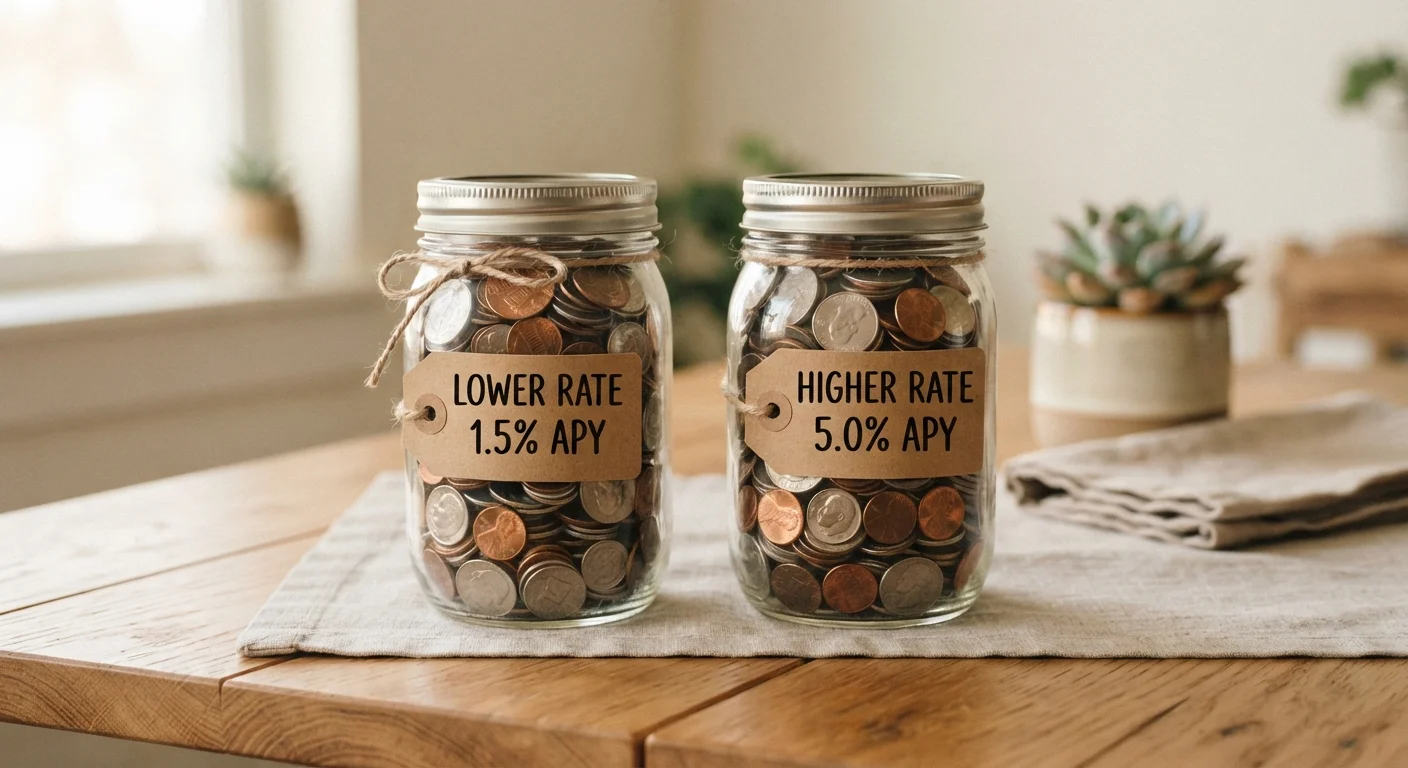
Photo: InsightsVilla.com | Quick Search. Right Info editorial
Key Takeaways
- High-yield savings accounts typically pay significantly more interest than traditional savings accounts.
- High-yield accounts are often offered by online banks, which have lower overhead costs.
- Both account types are generally FDIC-insured up to $250,000, so deposits are protected equally.
- Traditional savings accounts may offer in-person service and easier integration with existing bank accounts.
- Interest rates on both account types are variable and can change at any time.
How Each Account Type Works
Both high-yield and traditional savings accounts do the same basic job: they hold your money, keep it safe, and pay you interest on your balance. The core difference is how much interest they pay and where they're typically offered.
Traditional savings accounts are offered by most brick-and-mortar banks and credit unions. They're easy to open, often come bundled with a checking account, and let you visit a branch or ATM. The trade-off is that their interest rates - expressed as an Annual Percentage Yield, or APY - tend to be quite low. The national average for traditional savings accounts has historically hovered near the federal minimum, sometimes as low as 0.01% APY.
High-yield savings accounts operate the same way but pay considerably more interest. They're most commonly offered by online banks, which pass along cost savings from having no physical branches. APYs can be many times higher than what traditional banks offer, though rates vary by institution and change over time. See why your balance may barely grow at some banks for more on what keeps interest earnings low.
Side-by-Side Comparison
Here's how these two account types stack up across the factors that matter most to everyday savers.
| Traditional Savings Account | High-Yield Savings Account | |
|---|---|---|
| Typical APY | Very low (often near 0.01%-0.50%) | Higher (often several times the national average) |
| Where offered | Brick-and-mortar banks and credit unions | Primarily online banks |
| In-person access | Yes - branch and ATM access common | Rarely - mostly app and web-based |
| Transfer speed | Often instant within same bank | May take 1-3 business days externally |
| Monthly fees | Common unless minimums are met | Often none or minimal |
| FDIC/NCUA insured | Yes, up to $250,000 | Yes, up to $250,000 |
| Rate type | Variable - can change anytime | Variable - can change anytime |
It's worth noting that APYs on both account types are variable - meaning the bank can raise or lower them at any time, often in response to changes in the federal funds rate set by the Federal Reserve. Neither type locks in a rate. If a fixed rate appeals to you, a certificate of deposit may be worth exploring. See how CDs work and when they make sense for a comparison.
Access, Fees, and Everyday Practicality
Interest rate is only part of the picture. Here are a few practical factors to weigh before choosing.
Account Access
Traditional savings accounts shine here. You can visit a branch, use an ATM, and often transfer money instantly to a linked checking account at the same bank. Online high-yield accounts may take one to three business days to transfer funds to an external bank, which matters if you need money quickly.
Fees
Online banks offering high-yield accounts often charge fewer fees - no monthly maintenance fees is common. Traditional banks may charge monthly fees unless you meet a minimum balance requirement. Always read the account terms carefully.
FDIC Insurance
Both account types are typically insured by the Federal Deposit Insurance Corporation (FDIC) up to $250,000 per depositor, per institution. Credit union equivalents are insured by the NCUA. Your money is equally protected regardless of which type you choose, as long as the institution is federally insured.
Check the APY, Not Just the Rate Name
For a broader look at how online and traditional banks differ beyond just savings accounts, see online banks vs. brick-and-mortar banks.
Which Account Fits Your Situation?
The right choice depends on your priorities. If growing your savings balance over time is the main goal - say, building an emergency fund or saving toward a large purchase - a high-yield account generally gives you more for the same deposit. The difference compounds over months and years.
If you value being able to walk into a branch, work with a banker in person, or keep all your accounts under one roof at your existing bank, a traditional savings account avoids the friction of managing accounts at two separate institutions.
Some people use both: a traditional savings account for day-to-day buffer money and a high-yield account for longer-term savings they don't need instant access to. That's a reasonable approach, not an all-or-nothing decision.
If you're still deciding between a savings account and a checking account for your needs, the checking vs. savings comparison breaks down how those two account types serve different purposes.
This article is for general informational purposes only and does not constitute personalized financial advice. Consider speaking with a qualified financial professional regarding your specific situation.
The content on this site is for informational purposes only and is not a substitute for professional advice. Always consult a qualified professional for guidance specific to your situation.