
Debt Avalanche vs. Debt Snowball: Choosing a Payoff Strategy

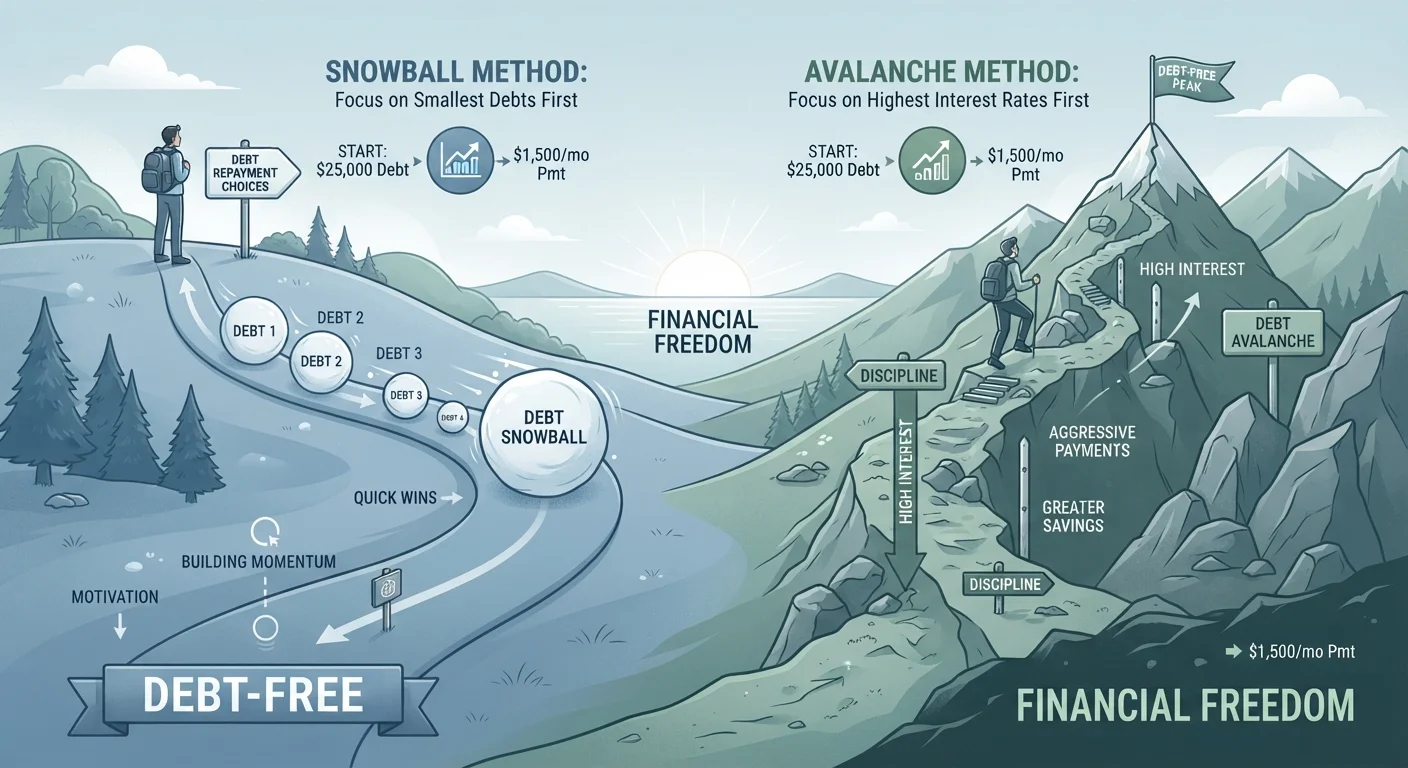
Photo: InsightsVilla.com | Quick Search. Right Info editorial
Key Takeaways
- The debt avalanche targets your highest-interest debt first, reducing total interest paid over time.
- The debt snowball targets your smallest balance first, delivering faster early wins to maintain motivation.
- Neither method is universally superior - your personality and financial situation determine the better fit.
- Both strategies require making minimum payments on all debts while directing extra money to one priority account.
- Consistency matters more than which method you choose - the best strategy is the one you'll stick with.
How Each Method Works
Both the debt avalanche and the debt snowball share the same basic mechanics: you make minimum payments on all your debts every month, then apply any extra money - whatever you can spare - to one designated account. The methods differ only in which account gets that extra attention.
Debt Avalanche: You rank your debts by interest rate, from highest to lowest, and put your extra payment toward the highest-rate balance first. Once that's paid off, you redirect that freed-up payment to the next highest rate, and so on. Because high-interest debt accumulates charges fastest, eliminating it early saves the most money overall.
Debt Snowball: You rank your debts by balance size, from smallest to largest, and attack the smallest balance first regardless of interest rate. Each time you clear a debt, you roll that payment into the next smallest. The idea, popularized by personal finance educators, is that crossing accounts off the list creates psychological momentum - each payoff feels like a win.
If you're new to how interest charges work on revolving debt, the credit and debt glossary covers terms like APR and minimum payment in plain language.
| Criterion | Debt Avalanche | Debt Snowball |
|---|---|---|
| Priority order | Highest interest rate first | Smallest balance first |
| Total interest paid | Lower (mathematically optimal) | Potentially higher |
| Time to first payoff | Longer (if high-rate debt is large) | Faster early wins |
| Motivational structure | Relies on discipline and patience | Built-in momentum from quick wins |
| Best when rates vary widely | Yes - rate gap amplifies savings | Less relevant to rate differences |
| Complexity | Requires tracking APRs | Straightforward balance ranking |
The Real Cost Difference
In purely mathematical terms, the avalanche wins on total interest paid - almost always. When you eliminate your most expensive debt first, less interest accumulates on your overall balance each month. Depending on your debt mix, the difference can range from modest to significant.
However, the snowball can close that gap if it keeps you in the game. A borrower who starts the avalanche, loses momentum after a year, and falls back into minimum-only payments ends up paying far more than someone who sticks with the snowball all the way through. Research in consumer behavior consistently finds that visible progress matters for sustained financial effort.
~$1,000+
Potential interest savings with avalanche method
Consumer finance analyses show the avalanche can save hundreds to over a thousand dollars compared to the snowball, depending on debt size and rate spread.
~3 in 4
Americans carrying some form of debt
Federal Reserve consumer finance surveys consistently find that the large majority of U.S. households carry at least one form of debt.
One practical consideration: if you have a debt with an interest rate dramatically higher than the others - such as a high-rate credit card sitting alongside a low-rate student loan - the avalanche's advantage grows. If rates are clustered close together, the financial difference between methods shrinks, and motivation becomes the deciding factor.
It's also worth noting that either method is a structured repayment plan, which is different from debt consolidation. Consolidation combines balances into a single new loan, often with a different rate. For a comparison of when consolidation makes sense, see what debt consolidation does and doesn't fix.
Choosing What's Right for Your Situation
There's no single correct answer, because the right strategy is the one you'll actually follow. Here are a few honest questions to help you decide:
- How do you respond to slow progress? If you can stay disciplined knowing that savings are happening in the background, the avalanche is a strong fit. If you need to see accounts close to stay motivated, the snowball is more likely to hold your attention.
- How large is the interest rate spread across your debts? Check each account's APR. A wide spread - say, 8% on one debt and 24% on another - makes the avalanche's advantage more concrete. Narrow spreads make it less meaningful.
- How many separate accounts are you managing? If you have many small balances cluttering your finances, clearing them quickly with the snowball can simplify your budget and reduce the mental load.
If your debt situation feels overwhelming or difficult to categorize, it may be worth reading about warning signs that debt is becoming unmanageable before choosing a method. In some cases, a structured repayment strategy may need to be paired with other steps.
For anyone building foundational knowledge before diving into repayment planning, Credit and Debt: A Starting Point for First-Time Borrowers is a solid place to start.
This article is for general informational and educational purposes only. It is not personalized financial advice. For guidance specific to your situation, consider consulting a qualified financial professional.
The content on this site is for informational purposes only and is not a substitute for professional advice. Always consult a qualified professional for guidance specific to your situation.