
Reading Your Auto Insurance Declarations Page

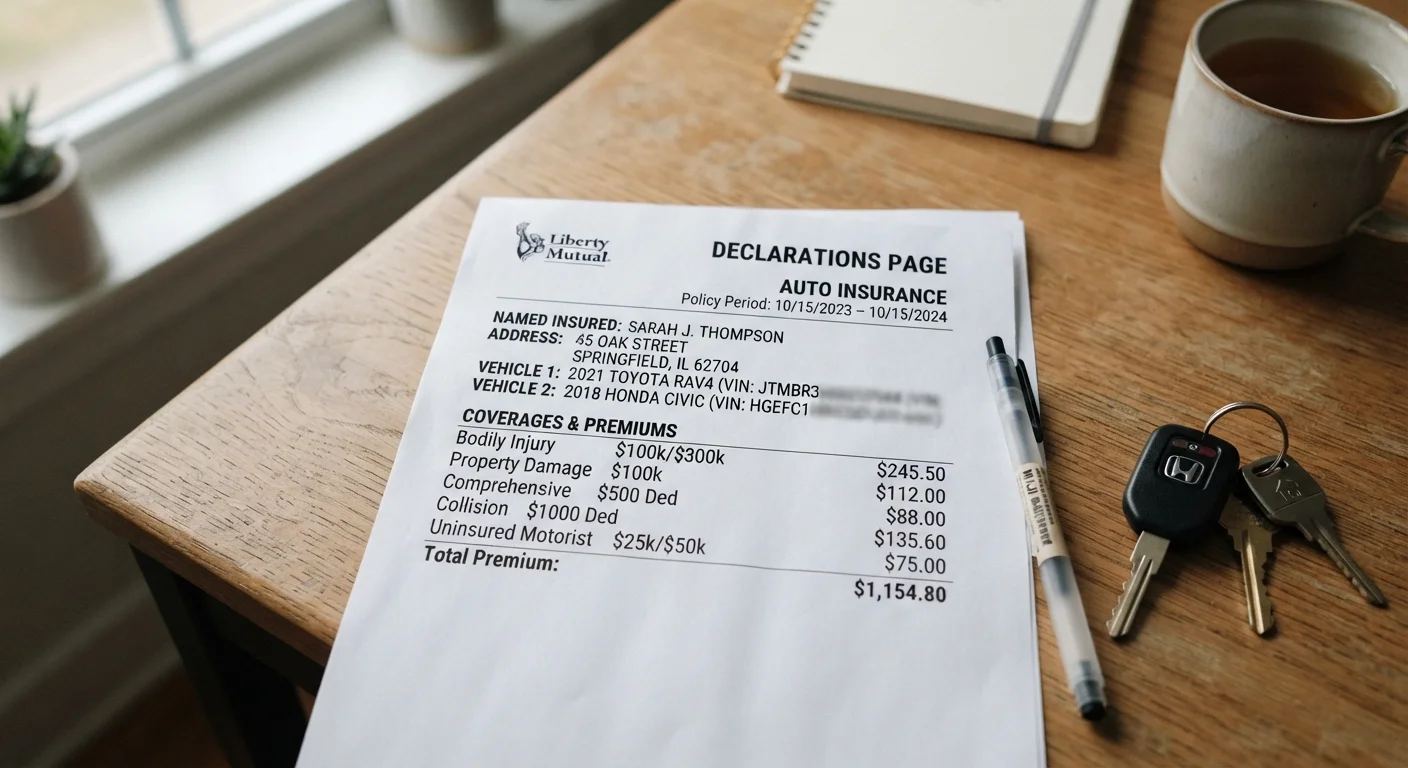
Photo: InsightsVilla.com | Quick Search. Right Info editorial
What Is a Declarations Page?
The declarations page - often called the "dec page" - is the cover sheet of your auto insurance policy. It compresses your entire coverage arrangement into one or two pages, listing who is insured, what vehicle is covered, what protections you carry, and how much each one costs. It is not a contract, but it is the fastest way to verify that your policy reflects what you actually agreed to pay for.
Insurers send an updated declarations page every time your policy renews or changes. Keep the current version somewhere accessible - in your glove compartment, a secure digital folder, or both. Understanding what each line means prevents surprises when you file a claim.
| Document type | Policy summary (not the full contract) |
| How often issued | At policy start and after any change or renewal |
| Typical policy period | 6 or 12 months |
| Key identifiers listed | Named insured, VIN, policy number, policy period |
| Coverage limits format (liability) | Per-person / per-accident (e.g., 50/100) |
| Deductible applies to | Collision and comprehensive coverages |
The Named Insured and Policy Period
At the very top of the dec page you will find the named insured - the person or persons legally covered under the policy. If you share a household with other licensed drivers, confirm they are listed correctly. An unlisted driver may face coverage complications after an accident, depending on your state's rules.
Directly below or beside that entry sits the policy period: the exact start and end dates of your coverage. Most personal auto policies run six or twelve months. Driving with an expired policy is the equivalent of driving uninsured, so note your renewal date and act before it lapses.
The dec page also shows your policy number - the reference you give your insurer, law enforcement, or another driver after an accident. Treat it like any other important account number.
Vehicle and Coverage Details
The vehicle section identifies the car by its year, make, model, and Vehicle Identification Number (VIN). Check this carefully. A typo in the VIN can complicate a claim settlement, so verify it against the sticker on your dashboard or door jamb.
Below the vehicle details is the section most people scan but rarely read closely: the coverage table. Each row lists a coverage type, a limit, and a premium. Common entries include:
- Bodily Injury Liability - written as two numbers (e.g., 50/100), meaning $50,000 per person and $100,000 per accident. This pays for injuries you cause to others.
- Property Damage Liability - the maximum your insurer pays for damage you cause to someone else's property.
- Uninsured/Underinsured Motorist - protects you when the at-fault driver carries little or no coverage.
- Collision - covers your vehicle after an impact with another car or object, minus your deductible.
- Comprehensive - covers non-collision losses such as theft, weather, or falling objects, also minus a deductible.
For a fuller explanation of what each coverage type does and when it applies, see our guide to auto insurance coverage types. If you want to understand exactly what collision and comprehensive do and do not pay for, see what comprehensive and collision coverage actually covers.
Declarations Page
A one- to two-page summary document issued by your insurer that outlines the key elements of your auto insurance policy, including covered vehicles, named insureds, coverages, limits, deductibles, and total premium.
Named Insured
The person or persons formally listed on the policy as primary policyholders. Other household members may be listed as additional drivers with varying levels of coverage depending on policy terms.
Coverage Limit
The maximum dollar amount your insurer will pay for a covered loss. Limits may be expressed per person, per accident, or per occurrence depending on the coverage type.
Deductible
The portion of a covered claim you pay before your insurer contributes. Higher deductibles typically result in lower premiums, and lower deductibles result in higher premiums.
Endorsement
An amendment or addition to your base auto insurance policy that adds, removes, or modifies coverage. Endorsements appear on the dec page with their own premium and conditions.
VIN (Vehicle Identification Number)
A unique 17-character code assigned to every motor vehicle. Insurers use it to confirm the exact vehicle covered under your policy.
Deductibles, Premiums, and Endorsements
Your deductible is the amount you pay out of pocket before your insurer covers the rest on a claim. It applies separately to collision and comprehensive. A higher deductible lowers your premium but raises your out-of-pocket exposure after an incident - a trade-off worth revisiting each renewal.
The premium column shows what each coverage costs individually, with a total at the bottom. Comparing these line items at renewal helps you spot rate changes and evaluate whether adjustments - like dropping collision on an older vehicle - make financial sense. Auto insurance is one of the larger recurring costs of vehicle ownership; for full context, see the true cost of owning a car in America.
Endorsements (sometimes called riders) are add-ons that modify your base policy. Common examples include rental reimbursement, roadside assistance, and gap coverage. Each endorsement listed on the dec page comes with its own premium and any applicable limits.
Errors on Your Dec Page Matter
Finally, note your insurer's contact information and your agent's name if one is assigned. These appear somewhere on the dec page and are your first call when a claim arises. State law also shapes how claims are handled - particularly whether you live in an at-fault or no-fault state, which affects who pays first. Learn more in our article on how fault and no-fault states affect your auto insurance claim.
The content on this site is for informational purposes only and is not a substitute for professional advice. Always consult a qualified professional for guidance specific to your situation.