
Tire Pressure and Why Getting It Wrong Costs You More Than You Think

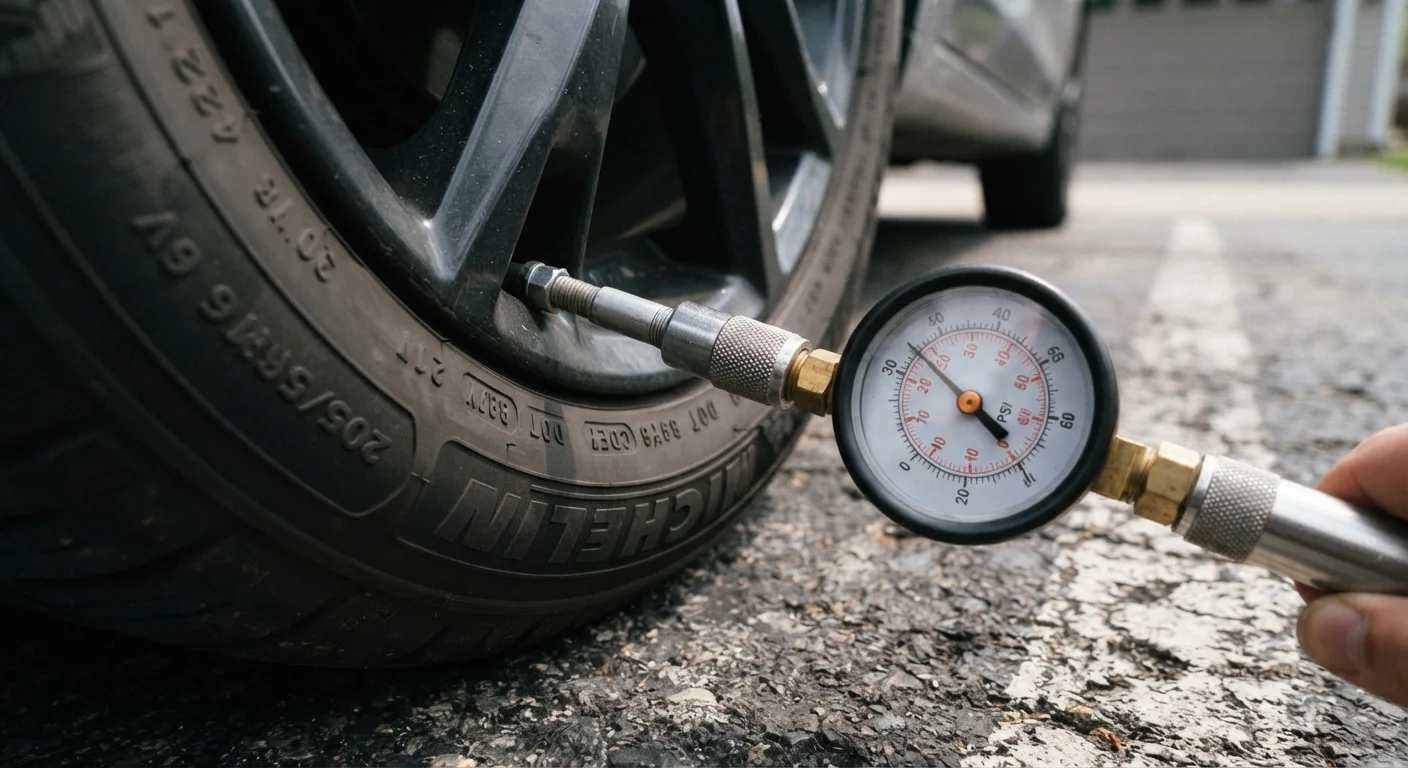
Photo: InsightsVilla.com | Quick Search. Right Info editorial
Key Takeaways
- Underinflated tires increase rolling resistance, which burns more fuel and wears tires unevenly.
- Overinflated tires reduce the contact patch with the road, hurting braking and grip.
- Temperature swings of 10°F can change tire pressure by roughly 1 PSI.
- The correct PSI for your car is on the driver's door jamb sticker, not on the tire itself.
- Checking pressure monthly and before long trips is the simplest, cheapest maintenance habit you can build.
What Happens Inside a Tire When Pressure Is Off
A properly inflated tire maintains an even, stable footprint against the road. When pressure is too low, the tire bulges outward and its shoulders - the outer edges of the tread - bear most of the load. The center of the tread barely touches the road, which causes shoulder wear that shortens tire life considerably. When pressure is too high, the opposite happens: the center of the tire balloons down and takes all the contact, causing premature center-tread wear and a harsher, bouncier ride.
Neither condition is just a wear issue. Underinflated tires flex more with every rotation, generating heat. Excessive heat is one of the leading causes of tire blowouts. Overinflated tires have less rubber contacting the pavement, which means less grip - a serious concern during hard braking or evasive maneuvers.
Front and Rear PSI May Differ
The Real Fuel Economy Penalty
Rolling resistance is the force a tire must overcome to keep rolling forward. A softer, underinflated tire deforms more with each rotation, which increases rolling resistance and forces the engine to work harder to maintain speed. The U.S. Department of Energy has noted that fuel economy can drop by roughly 0.2% for every 1 PSI drop in pressure across all four tires - a small number that compounds quickly when tires are chronically 5-10 PSI low.
Over the course of a year of daily driving, that fuel penalty adds up to real money at the pump. Paired with faster tire wear from uneven contact, the total cost of neglecting tire pressure is far higher than the price of a $10 gauge and five minutes of attention each month. See how tire care fits into the full picture of car ownership costs.
~0.2%
Fuel economy lost per 1 PSI drop
According to the U.S. Department of Energy, underinflation by just 1 PSI across all four tires reduces fuel efficiency by approximately 0.2%.
25%
Pressure drop required to trigger TPMS alert
Federal TPMS regulations require a warning only when pressure falls 25% below the vehicle manufacturer's recommended level - meaning efficiency losses begin well before any alert appears.
1 PSI
Pressure change per 10°F temperature shift
Tire pressure rises or falls roughly 1 PSI for every 10-degree Fahrenheit change in ambient temperature, according to widely cited tire industry guidance.
Temperature, Seasons, and the TPMS Light
Tire pressure is not static - it fluctuates with temperature. Air contracts when cold and expands when warm, which means your tire pressure can shift 5 PSI or more between a hot August afternoon and a January morning. Many drivers first notice the amber TPMS (Tire Pressure Monitoring System) warning light in autumn, simply because overnight temperatures dropped enough to push tires below threshold.
The TPMS is a valuable safety feature, but it has a meaningful limitation: federal regulations require it to alert you when pressure is 25% below the recommended level. By that point, you've already been driving on underinflated tires long enough to affect efficiency and wear. Relying solely on the TPMS is a reactive strategy. Monthly checks with an inexpensive gauge keep you ahead of the problem. This is one of the quiet habits that wear out your car faster than it should.
Finding the Right PSI and Checking It Correctly
The single most important thing to know: the correct PSI for your vehicle is printed on a sticker inside the driver's door jamb, and in your owner's manual. It is not the maximum PSI molded into the tire sidewall - that number is the tire's structural limit, not a target. Many drivers inflate to the sidewall number by mistake, leading to chronic overinflation.
For an accurate reading, check pressure when the tires are cold - meaning the car has been parked for at least three hours or driven fewer than a mile. Heat from driving expands the air inside and gives a falsely high reading. Unscrew the valve cap, press your gauge firmly and squarely onto the valve stem, read the result, and compare it to your door jamb recommendation. Add or release air as needed. For broader context on how this maintenance habit pairs with other money-saving strategies, see keeping car ownership costs manageable.
Check Tires When They're Cold
How Tire Pressure Connects to Other Tire Services
Tire pressure doesn't exist in isolation. A tire running chronically low will develop uneven wear patterns that rotation alone can't fix. Similarly, a car that's out of alignment will cause uneven wear even on properly inflated tires. These systems interact - which is why understanding each one matters. If you're unclear on how rotation, balancing, and alignment differ from each other, our guide to those three services breaks each one down clearly.
Keeping pressure at the correct level is the foundation. It's the one maintenance task you can do yourself, for free, in a parking lot - and it has a measurable effect on safety, cost, and tire longevity every single mile you drive.
Frequently Asked Questions
The content on this site is for informational purposes only and is not a substitute for professional advice. Always consult a qualified professional for guidance specific to your situation.