
Regional Slang That Reveals How Differently Americans Speak

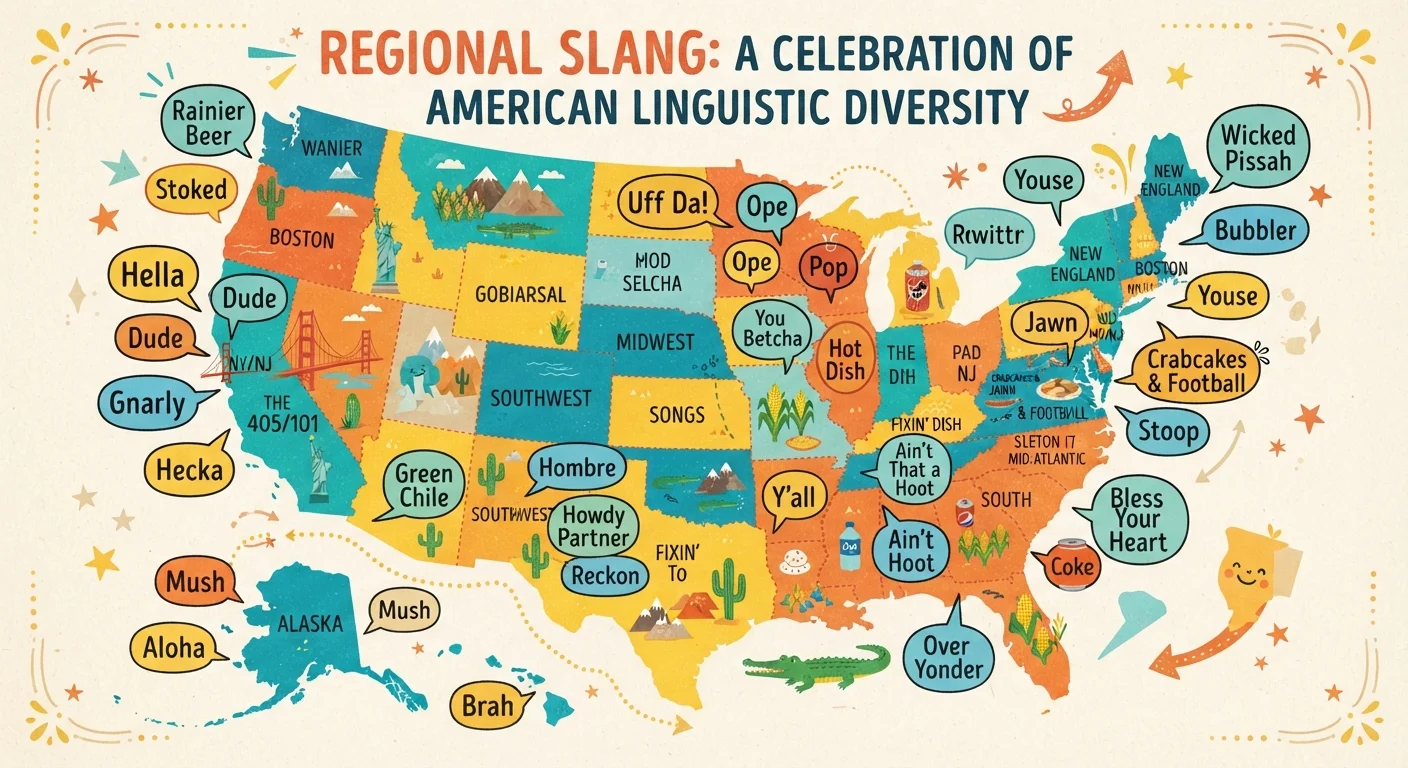
Photo: InsightsVilla.com | Quick Search. Right Info editorial
Key Takeaways
- American regional slang reflects deep cultural roots, migration patterns, and local identity.
- Words for the same everyday item - like a carbonated drink - can vary dramatically by region.
- Understanding regional language differences builds empathy and bridges social divides.
- Slang is living language: it shifts, travels, and evolves with communities over time.
Why the Way You Talk Tells a Story
Ask someone in Boston for a "frappe" and you'll get a milkshake. Order the same thing in the Midwest and you might get a blank stare. Across the United States, the words people use for everyday things - drinks, roads, shopping carts, even you and your friends - can shift the moment you cross a state line.
American English is not a single, unified language. It's a patchwork of dialects shaped by immigration waves, Indigenous languages, geography, and generations of cultural exchange. Linguists have studied these variations for decades, and what they find is consistently striking: the words we grow up with feel natural and obvious to us - and genuinely foreign to someone raised just a few hundred miles away.
These differences aren't just fun trivia. They're windows into regional identity and community pride. As you'll see in the list below, how Americans talk to each other is shaped in no small part by where they're from. And if you've ever felt like an outsider when your word for something drew confused looks, know this: you're not alone, and you're part of something far bigger.
"Y'all" - The South's All-Purpose Second-Person Plural
Perhaps the most beloved and debated word in American regional speech, "y'all" serves as the second-person plural pronoun throughout much of the South and parts of Texas. It fills a genuine grammatical gap - standard American English has no clear plural "you" - and Southerners use it with warmth and efficiency.
"Y'all" has roots in Scots-Irish English and African American Vernacular English, both of which shaped Southern speech profoundly. Interestingly, it's been spreading northward and westward for years, popping up in cities far from its origin. For many speakers, it's not just grammar - it's a greeting, an embrace, and a signal that everyone in the room is included.
"Y'all" fills a real grammatical gap and carries unmistakable Southern warmth with it.
"Pop" vs. "Soda" vs. "Coke" - The Great Soft Drink Divide
Few linguistic fault lines in America are as fiercely felt as what you call a carbonated soft drink. The Midwest and Pacific Northwest largely say "pop." The Northeast, California, and parts of the South say "soda." And across much of the Deep South, any carbonated beverage - regardless of brand - might simply be called "Coke."
Researchers at Harvard's dialect survey and similar projects have mapped these boundaries in detail, and the borders are surprisingly sharp. Ask someone which word feels right and you'll often trigger a strong reaction - people feel that their word is simply the correct one. That certainty is itself a window into how deeply language connects to place and upbringing.
Whether you say pop, soda, or Coke reveals where you grew up more reliably than almost anything else.
"Wicked" - New England's All-Purpose Intensifier
In most of the country, "wicked" describes something sinister. In New England - and especially Massachusetts - it functions as an intensifier meaning "very" or "extremely." Something can be "wicked good," "wicked cold," or "wicked far away." The word carries no negative connotation whatsoever in this context.
This usage is thought to have roots in older English dialects and was reinforced by the region's distinct cultural insularity over centuries. Visitors to Boston often do a double-take the first time they hear it used casually in positive sentences. For locals, it's simply how emphasis works - and using it correctly signals you belong.
In New England, "wicked" is a compliment - a regional intensifier that visitors rarely see coming.
"The City" - What Locals Mean Depends on Where You Stand
Across the country, referring to "the city" without specifying which city is a reliable regional tell. In the New York tri-state area, it almost always means Manhattan. In the San Francisco Bay Area, it typically refers to San Francisco itself. In Illinois, it usually means Chicago - even in towns hours away.
This shorthand reveals how a single dominant urban center shapes the mental geography of an entire surrounding region. The phrasing carries assumptions about shared knowledge that feel obvious to insiders and completely opaque to outsiders. It's one of the subtler ways that where you live shapes your daily frame of reference.
"The city" means something completely different depending on which state you're standing in.
"Bubbler," "Water Fountain," or "Drinking Fountain" - Hydration by Region
What do you call the fixture in a school hallway where you get a sip of water? Most Americans say "water fountain" or "drinking fountain." But in Wisconsin and parts of Rhode Island and Massachusetts, the answer is "bubbler" - a term that traces back to a trademarked name used by a plumbing manufacturer in the early 20th century.
The word "bubbler" has persisted in those regions long after the trademark significance faded, kept alive purely by community habit and local loyalty. It's a perfect example of how commercial language can fossilize into regional identity - and how stubbornly communities hold onto what feels like theirs.
Calling it a "bubbler" is one of the most specific regional tells in the entire country.
"Hella" - Northern California's Export to the Wider World
Originating in the Bay Area of Northern California, "hella" functions much like New England's "wicked" - it's an intensifier meaning "very" or "a lot." Something can be "hella good," "hella expensive," or "hella far." The word spread through hip-hop and youth culture in the 1990s and 2000s and is now recognized - if not always used - far beyond California.
Linguists have noted that "hella" traveled faster and farther than most regional slang because it was carried by music and media with national reach. Still, its heaviest use remains in Northern California, where it started. Using it fluently in the Bay Area signals cultural familiarity; using it incorrectly anywhere tends to signal the opposite.
"Hella" traveled from the Bay Area to national pop culture, but its heart is still Northern California.
Language as a Living Map of American Life
Regional slang isn't a quirk or a flaw - it's evidence of how richly diverse American life really is. Just as holiday traditions differ dramatically by region, the language people use to navigate daily life carries the fingerprints of local history and community.
Curious About Your Own Dialect?
The next time someone uses a word you don't recognize, it's worth asking where they grew up. That single question can open a genuinely warm conversation about place, memory, and belonging - and remind both of you that American identity is wider and richer than any one accent or phrase.
The content on this site is for informational purposes only and is not a substitute for professional advice. Always consult a qualified professional for guidance specific to your situation.