
Compound Interest Over Time: Why Starting Early Changes Everything

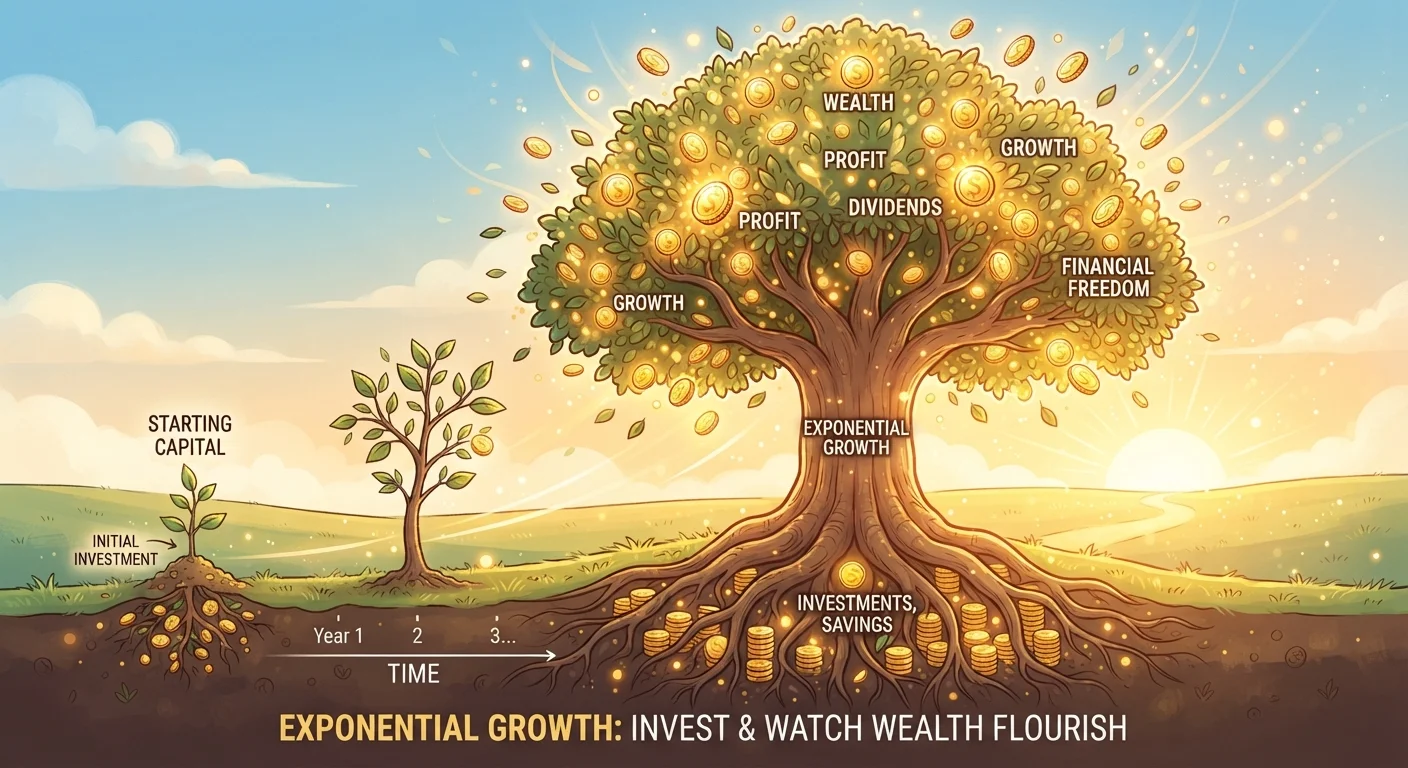
Photo: InsightsVilla.com | Quick Search. Right Info editorial
Key Takeaways
- Compound interest earns returns on both your principal and previously earned interest.
- The earlier you start saving, the more time compounding has to multiply your balance.
- Compounding frequency (daily vs. monthly) affects how much you actually earn.
- Time in the market matters more than the size of your initial deposit.
- The same compounding mechanic that grows savings also grows debt.
How Compound Interest Actually Works
Start with a simple example. You deposit $1,000 into a savings account earning 5% interest per year. After year one, you've earned $50 in interest - bringing your balance to $1,050. In year two, you don't earn interest on just the original $1,000. You earn it on $1,050. That difference seems small at first, but it compounds.
This is the core mechanic: interest earns interest. The balance that generates your returns keeps growing, so each period's gain is slightly larger than the last. Over five or ten years, that snowball effect becomes clearly visible in your account balance.
To understand what your savings account is actually paying you, look at the APY (Annual Percentage Yield) rather than the stated interest rate. APY reflects the effect of compounding, giving you an apples-to-apples number for comparison. See how savings accounts actually earn you money for a full breakdown of how APY works.
$1,629
Value of $1,000 after 10 years at 5% APY
Illustrative calculation assuming no additional contributions and annual compounding at a fixed 5% rate.
2x+
Potential difference from starting 10 years earlier
Time horizon is widely cited by financial educators as the single most powerful factor in long-term savings growth.
365x
Daily compounding cycles per year
Many savings accounts compound interest every day, meaning your balance grows slightly each day it sits in the account.
Why Time Is the Most Important Variable
The math behind compounding rewards patience in a way that feels almost unfair. Consider two people: one starts saving at 25, the other at 35. Both contribute the same amount each month and earn the same interest rate. By retirement, the person who started ten years earlier will typically end up with a significantly larger balance - sometimes double or more - despite contributing for only a decade longer.
That gap exists because compounding is exponential, not linear. In the early years, gains look modest. But as the balance grows, each year's interest payment gets larger in absolute dollars. The longer that process runs uninterrupted, the more dramatic the acceleration becomes.
This is why financial educators consistently emphasize starting early, even if initial contributions are small. A $50-per-month habit at 22 often outperforms a $200-per-month habit started at 40.
Start Small - But Start Now
Compounding Frequency: Daily vs. Monthly
Not all accounts compound at the same rate. Some calculate and add interest daily; others do it monthly or even annually. The more frequently compounding occurs, the more you earn - though the difference between daily and monthly compounding is modest at typical savings rates.
What matters more than compounding frequency is the interest rate itself. An account compounding daily at a low rate will still underperform an account compounding monthly at a meaningfully higher rate. If you notice your savings balance is barely moving, it may be worth understanding why. Some banks pay very little interest, and low rates can make compounding nearly invisible.
If you want a higher rate with a predictable structure, a certificate of deposit (CD) locks in your rate for a set term, which can be a useful tool when rates are favorable.
APY vs. Interest Rate: Know the Difference
The Other Side: Compound Interest on Debt
Compounding doesn't only grow your savings - it grows what you owe, too. On a credit card, interest is typically calculated daily on your outstanding balance. If you don't pay it off, that interest gets added to your balance, and next month's interest is calculated on the new, higher total.
This is why carrying a credit card balance is so costly. The same mechanic that quietly builds your savings account can quietly expand your debt. For a clear look at how that works, see how interest compounds on credit card balances.
Understanding both sides of compounding gives you a more complete picture of personal finance. It reinforces why paying off high-interest debt quickly - and building savings consistently - tends to be sound general practice. For broader context on managing money, the Budgeting Basics hub covers foundational frameworks worth knowing.
This article is for general informational purposes only and does not constitute personalized financial advice. For guidance specific to your situation, consider consulting a qualified financial professional.
Frequently Asked Questions
The content on this site is for informational purposes only and is not a substitute for professional advice. Always consult a qualified professional for guidance specific to your situation.