
APY vs. APR: Two Rates That Mean Very Different Things

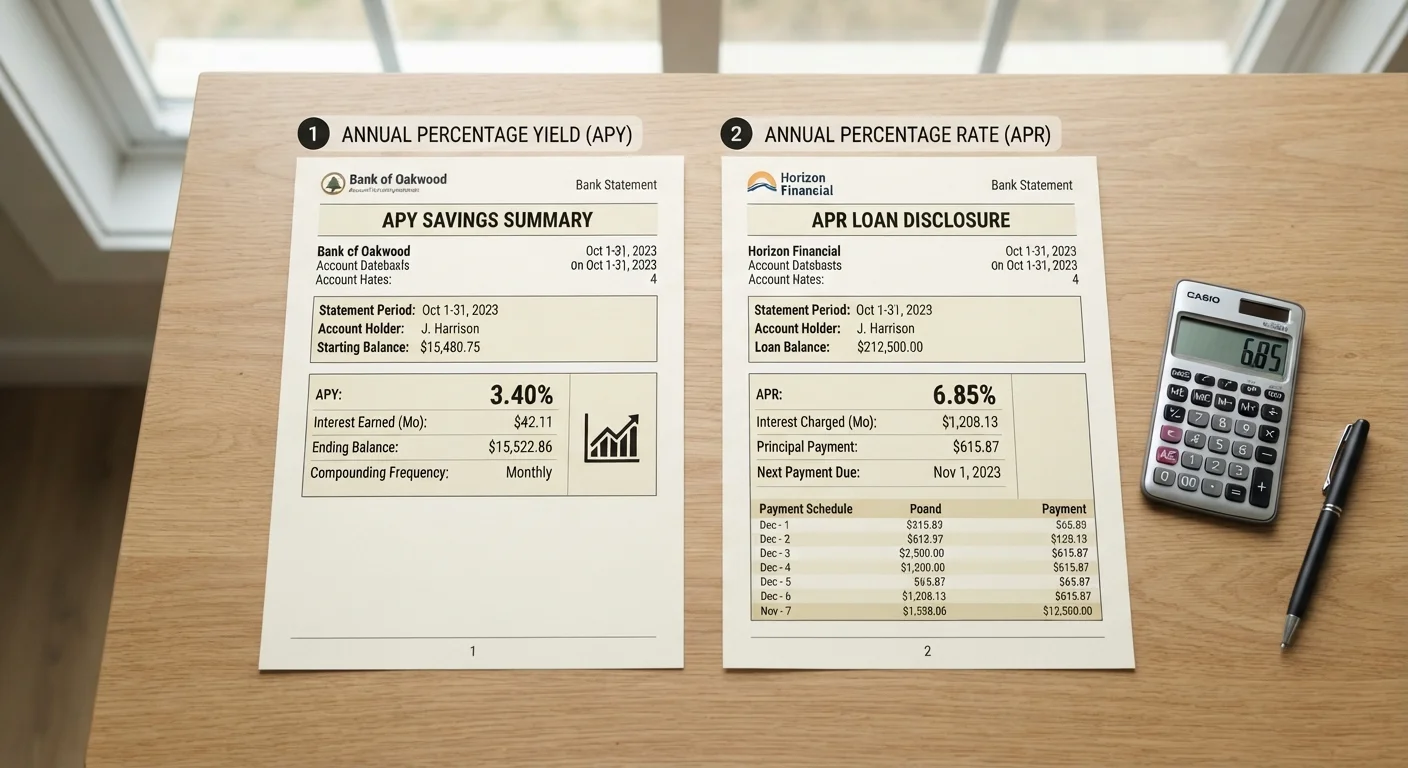
Photo: InsightsVilla.com | Quick Search. Right Info editorial
Key Takeaways
- APY reflects compounding interest, so it shows the true annual return on a savings product.
- APR does not include compounding, making it a baseline cost figure for loans and credit.
- Higher APY is better when saving; lower APR is better when borrowing.
- Banks are required by law to disclose both rates in certain contexts, but not always together.
- Comparing APY to APR directly is an apples-to-oranges mistake that can lead to poor decisions.
What Each Rate Actually Measures
At first glance, APY and APR look nearly identical - both are annual percentage figures attached to financial products. But they measure completely different things, and mixing them up can give you a distorted picture of how much you're earning or paying.
APY (Annual Percentage Yield) tells you how much interest you'll earn on a deposit over one year, after accounting for compounding. Compounding means that interest you earn gets added to your balance, and then that larger balance earns more interest. The more frequently compounding happens - daily, monthly, quarterly - the higher the APY relative to the base interest rate.
APR (Annual Percentage Rate) tells you the annual cost of borrowing money, expressed as a percentage. Unlike APY, APR does not factor in compounding. On loans and credit cards, it represents the interest rate plus certain fees spread over the life of the loan. Because it's standardized by federal law (the Truth in Lending Act), it's useful for comparing offers from different lenders.
A simple way to remember the difference: APY is what a bank pays you; APR is what a lender charges you. See our credit and debt glossary for plain-language definitions of other terms that appear in loan documents.
| Criterion | APY | APR |
|---|---|---|
| Stands for | Annual Percentage Yield | Annual Percentage Rate |
| Includes compounding | Yes | No |
| Used for | Savings, CDs, money market accounts | Loans, credit cards, mortgages |
| Higher or lower is better | Higher is better (more earned) | Lower is better (less paid) |
| May include fees | No | Often yes, on loans |
| Required disclosure | Truth in Savings Act (deposits) | Truth in Lending Act (credit) |
Why Compounding Makes APY Larger Than the Base Rate
If a savings account advertises a 5% interest rate compounded monthly, the APY will be slightly higher than 5% - because each month's interest is added to the principal before the next month's interest is calculated. Over a full year, those small additions stack up.
This is exactly why savings account providers advertise APY rather than the plain interest rate - it's the larger, more attractive number, and it's also the more accurate one. When you're comparing high-yield savings accounts to traditional savings accounts, APY is the right number to focus on.
365x
Daily compounding frequency
Many savings accounts compound interest daily, meaning your balance grows slightly every day before interest is credited monthly.
~0.01%
Typical traditional savings APY
The FDIC reports that the national average APY for traditional savings accounts has historically remained well below 1% at many large banks.
For borrowers, the absence of compounding in APR can be misleading in a different direction. Credit card debt, for example, compounds monthly - meaning the actual cost of carrying a balance is higher than the APR alone suggests. The APR is a useful benchmark for comparison, but it underrepresents the real cost if you're only making minimum payments.
For a deeper look at how interest builds in deposit accounts, see how savings accounts actually earn you money.
Practical Rules for Using These Rates
The most important rule: never compare APY directly to APR. They're calculated differently and used for different products. Comparing them is like comparing a sale price to a sticker price - the numbers don't mean the same thing.
When evaluating savings products - bank accounts, certificates of deposit, money market accounts - look for the APY. It gives you the real annual return. When evaluating borrowing products - mortgages, auto loans, personal loans, credit cards - look at the APR. It gives you a standardized cost to compare across lenders.
APR on Credit Cards Is Not the Whole Story
One more thing worth knowing: on certain loan products, the APR can include origination fees, points, and other charges - meaning it may be higher than the base interest rate the lender quotes in advertisements. That's actually useful to borrowers because it surfaces hidden costs. If you're shopping for an auto loan, our article on auto loan terms that catch borrowers off guard explains how dealer markups on APR and other less-visible costs can affect what you ultimately pay.
This article is for general informational and educational purposes only and does not constitute personalized financial advice. Consult a qualified financial professional for guidance specific to your situation.
The content on this site is for informational purposes only and is not a substitute for professional advice. Always consult a qualified professional for guidance specific to your situation.