
Whole Grains vs. Refined Grains: What Changes When Wheat Gets Processed

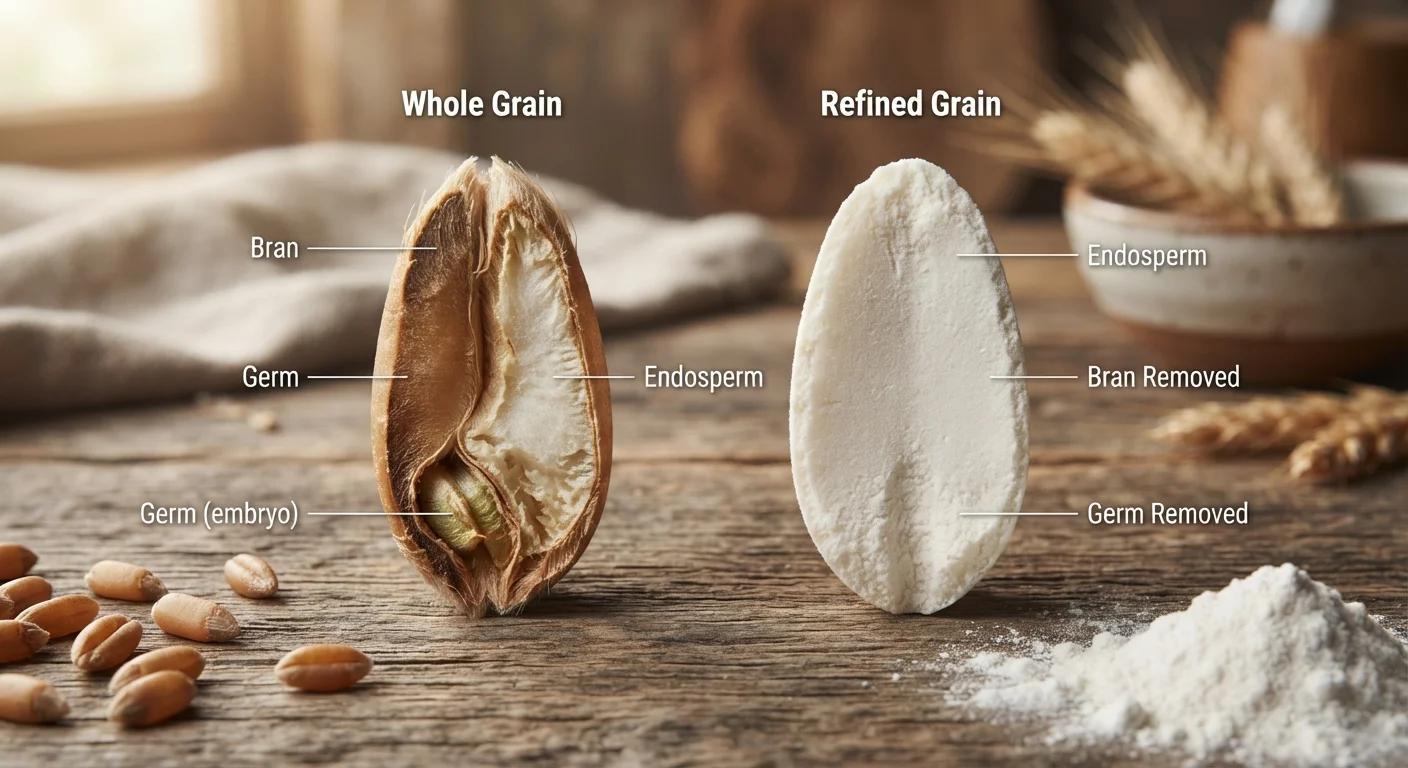
Photo: InsightsVilla.com | Quick Search. Right Info editorial
Key Takeaways
- Refining removes the bran and germ, stripping most fiber, B vitamins, and minerals from the grain.
- Enriched refined grains have some nutrients added back, but fiber and many phytonutrients are not restored.
- Whole grains are linked to lower risk of heart disease and type 2 diabetes in large observational studies.
- Glycemic response tends to be higher with refined grains due to the removal of fiber.
- Reading ingredient labels helps identify whether a product is truly whole grain or mostly refined.
- Swapping some refined grain servings for whole grains is a practical, evidence-supported dietary shift.
What Actually Happens Inside the Mill
A grain kernel has three distinct layers: the bran (the fibrous outer shell), the germ (the nutrient-dense embryo), and the endosperm (the starchy interior). Whole grains keep all three intact. Refining - the milling process used to produce white flour or white rice - removes the bran and germ, leaving only the endosperm.
That structural change has significant nutritional consequences. The bran contributes the vast majority of a grain's dietary fiber, along with B vitamins like niacin and thiamine. The germ is rich in vitamin E, healthy fats, and additional B vitamins. When those two layers are stripped away, the calorie-to-nutrient ratio of the remaining product shifts dramatically in favor of calories.
In the United States, many refined grain products are enriched - meaning manufacturers add back certain nutrients, primarily iron and B vitamins like folic acid, that were lost in processing. Enrichment has had genuine public health benefits: fortification with folic acid, for instance, has contributed to a documented decline in neural tube defects. However, enrichment does not restore fiber, vitamin E, magnesium, or the various phytochemicals (beneficial plant compounds) found in the original whole grain.
| Criterion | Whole Grains | Refined Grains |
|---|---|---|
| Parts of kernel retained | Bran, germ, endosperm | Endosperm only |
| Dietary fiber | High (mostly intact) | Very low (mostly removed) |
| B vitamins (natural) | Good natural source | Largely removed; some added back via enrichment |
| Vitamin E | Present (from germ) | Largely absent |
| Glycemic index (typical) | Lower (fiber slows digestion) | Higher (faster digestion) |
| Phytonutrients | Broad range retained | Substantially reduced |
| Shelf life | Shorter (germ oils can go rancid) | Longer (oils removed) |
| Examples | Whole wheat bread, brown rice, oats, quinoa | White bread, white rice, most pastries |
How the Difference Shows Up in Your Body
The most well-documented downstream effect of refining is on glycemic response - the speed at which blood glucose rises after eating. Intact fiber slows digestion and the absorption of carbohydrates. Without it, refined grain foods are digested more quickly, producing a faster and often higher spike in blood sugar. This is measured by a food's glycemic index (GI), a scale that ranks how rapidly a food raises blood glucose relative to pure glucose.
25%
Fiber lost in white rice milling
Milling brown rice to white removes roughly 75-80% of the fiber, according to USDA nutrient data comparisons between the two forms.
~70
Glycemic index of white bread
White bread typically registers around 70-75 on the glycemic index scale, while whole wheat bread generally scores in the 50-65 range, according to published GI database research.
3x
More magnesium in whole wheat flour
USDA nutrient data show that whole wheat flour contains approximately three times more magnesium per 100g than enriched all-purpose white flour.
Over time, repeated rapid blood glucose spikes are associated with greater insulin demand. Large observational studies - including research drawn from the Nurses' Health Study and other long-running cohorts - have found associations between diets high in refined grains and elevated risk of type 2 diabetes and cardiovascular disease. These are associations, not proven cause-and-effect relationships, and diet is only one variable among many. Still, the consistent direction of the evidence has led major health organizations, including the Dietary Guidelines for Americans, to recommend that at least half of daily grain servings come from whole grain sources.
For practical context, knowing how to read a Nutrition Facts label can help you compare fiber and nutrient content between grain products before you buy.
Reading Labels: Spotting the Difference on the Shelf
Marketing language around grains is frequently misleading. Products labeled multigrain, wheat bread, or made with whole grain are not necessarily predominantly whole grain. The only reliable indicator is the ingredient list.
Look for a whole grain listed as the first ingredient - for example, whole wheat flour, whole oats, or whole grain corn. If the first ingredient is simply wheat flour, enriched flour, or rice flour, the product is primarily refined. The word whole must appear before the grain name to indicate that the bran and germ are included.
Color is not a reliable guide. Brown bread can be tinted with molasses. White whole wheat flour - milled from a lighter variety of wheat - produces pale bread that is still a true whole grain. Understanding these distinctions connects directly to the broader skill of reading ingredient context critically, which applies across many food categories.
Enrichment vs. Whole Grain: Not the Same Thing
This article is for general informational and educational purposes only and is not a substitute for advice from a qualified healthcare provider or registered dietitian.
The content on this site is for informational purposes only and is not a substitute for professional advice. Always consult a qualified professional for guidance specific to your situation.