
Home Workouts vs. Gym Workouts: What Each Setup Actually Offers

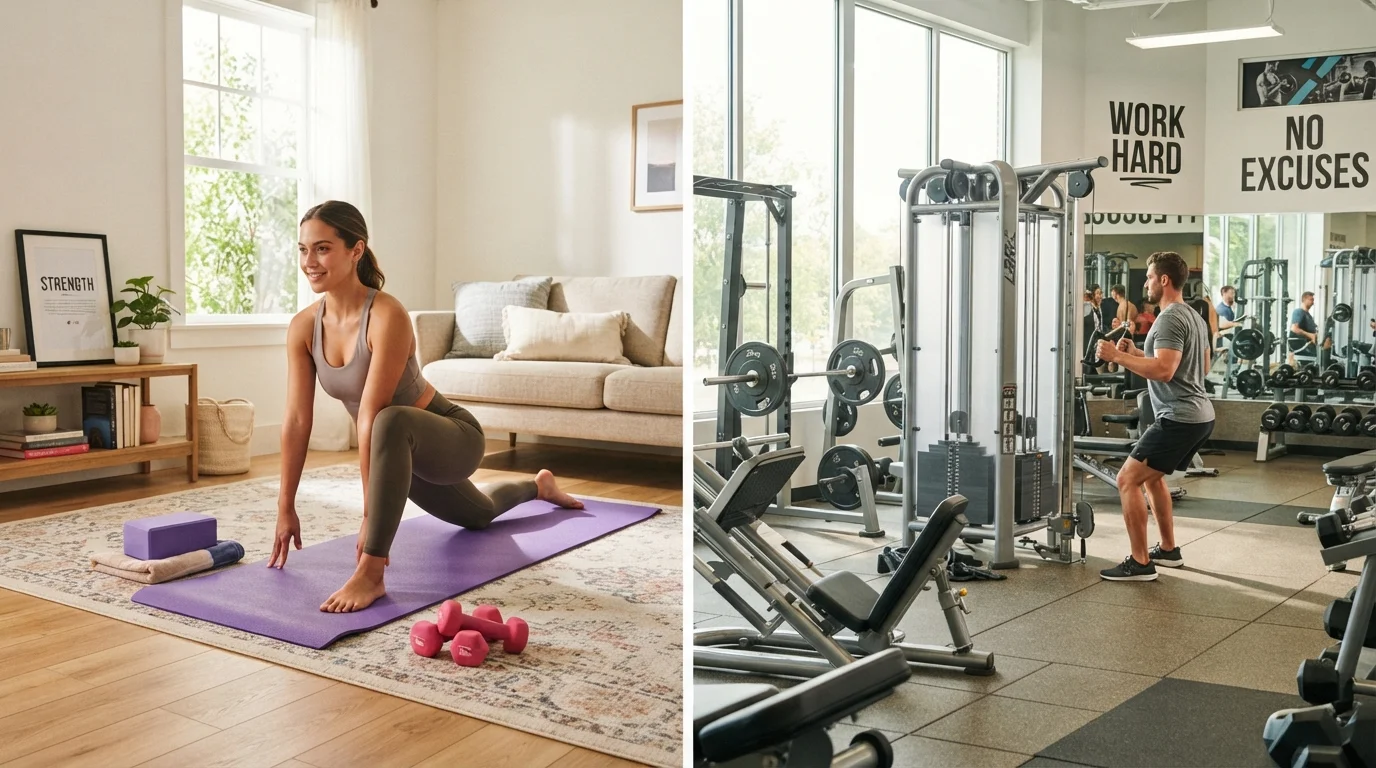
Photo: InsightsVilla.com | Quick Search. Right Info editorial
Key Takeaways
- Home workouts offer unmatched convenience and zero commute, but equipment is limited unless you invest.
- Gyms provide a wider range of equipment and structured environments that some people find motivating.
- Cost, space, personal preference, and fitness goals all influence which setup works best.
- Both environments can support effective, sustainable fitness habits when used consistently.
- Hybrid approaches - combining home and gym training - are a practical option for many people.
What Each Setup Actually Provides
Before deciding where to work out, it helps to understand what each environment genuinely offers - rather than what fitness marketing suggests. Before diving into comparisons, if you're new to exercise terminology, our plain-language fitness reference covers foundational terms worth knowing.
Home workouts can range from bodyweight-only sessions requiring no equipment to fully outfitted spare rooms. The defining advantage is proximity: your workout starts the moment you decide to move. There's no commute, no wait for equipment, and no membership fees once your setup is in place.
Gym workouts provide access to a wide range of resistance machines, free weights, cardio equipment, and often group fitness classes. For people pursuing specific goals - like powerlifting progressions or supervised rehabilitation - a gym's infrastructure may be genuinely necessary rather than simply preferable.
| Home Workouts | Gym Workouts | |
|---|---|---|
| Upfront Cost | Low to moderate (equipment optional) | Low (membership fee only) |
| Ongoing Cost | Minimal after initial setup | Monthly or annual membership fees |
| Convenience | Very high - no commute required | Depends on gym proximity and hours |
| Equipment Variety | Limited unless heavily invested | Extensive - machines, free weights, cardio |
| Privacy | Complete privacy | Shared public space |
| Social Motivation | Minimal unless virtual | Group classes, community atmosphere |
| Progression for Strength Goals | Possible, but requires investment | Easier with incremental weights available |
| Flexibility of Schedule | 24/7 - fully flexible | Dependent on gym operating hours |
Convenience, Cost, and Commitment
Convenience is one of the most underrated factors in fitness adherence. Research on exercise behavior consistently identifies perceived barriers - including travel time - as a primary reason people abandon routines. A home environment removes that barrier almost entirely.
Cost comparisons are less straightforward. Gym memberships in the U.S. typically range from modest community facility fees to premium monthly rates at commercial chains. Home setups have higher upfront costs if you purchase equipment, but no recurring fees. Over several years, a well-chosen home setup can be more economical - though a bare-bones gym membership can also remain affordable if used consistently.
Start With What You'll Actually Use
It's also worth recognizing that commitment works differently in each setting. Some people find that leaving home and entering a gym activates a mental shift into "workout mode" that's harder to replicate in a living room. Others find the gym's social dynamics or crowded peak hours demotivating. Neither response is wrong - they reflect genuine individual differences in how environments shape behavior.
Effectiveness: Can You Get the Same Results?
For general fitness and health - cardiovascular conditioning, muscle maintenance, flexibility, and stress reduction - home workouts are fully capable of delivering meaningful results. Bodyweight exercises like push-ups, squats, lunges, and planks engage major muscle groups effectively. Resistance bands and a pair of adjustable dumbbells significantly expand what's achievable at home.
Where gyms hold a practical edge is in progressive overload (gradually increasing the challenge to keep stimulating adaptation). A gym's incremental weight plates and specialized machines make structured progression easier, particularly for intermediate and advanced strength training. If building significant muscle mass or training for competitive lifting are explicit goals, a gym environment is harder to replicate at home without substantial investment.
For a deeper look at how different types of exercise affect your body, see our comparison of strength training vs. cardio.
~30%
Gym members who exercise regularly
Industry estimates suggest a significant portion of gym members attend infrequently, underscoring that membership alone doesn't guarantee consistency.
150 min
Weekly moderate activity recommended
The U.S. Department of Health and Human Services recommends at least 150 minutes of moderate-intensity aerobic activity per week for adults - achievable in either setting.
Making the Right Choice for Your Life
The most effective workout is the one you'll do consistently - a principle that sounds simple but carries real weight. If gym environments feel intimidating, our guide to building a movement habit without a gym offers practical strategies for staying active on your own terms.
A hybrid approach works well for many people: using a gym two or three days a week for equipment-dependent training while relying on home workouts for lighter recovery sessions or days when time is tight. This flexibility often produces better long-term adherence than committing rigidly to one setting.
It's also worth remembering that structured workouts are only part of the fitness picture. How much you move throughout the day - walking, standing, taking stairs - contributes meaningfully to overall health regardless of your primary workout setting.
This article is for general informational and educational purposes only and is not a substitute for professional medical or fitness advice. Consult a qualified healthcare provider or certified fitness professional before beginning any new exercise program, particularly if you have existing health conditions or concerns.
The content on this site is for informational purposes only and is not a substitute for professional advice. Always consult a qualified professional for guidance specific to your situation.